
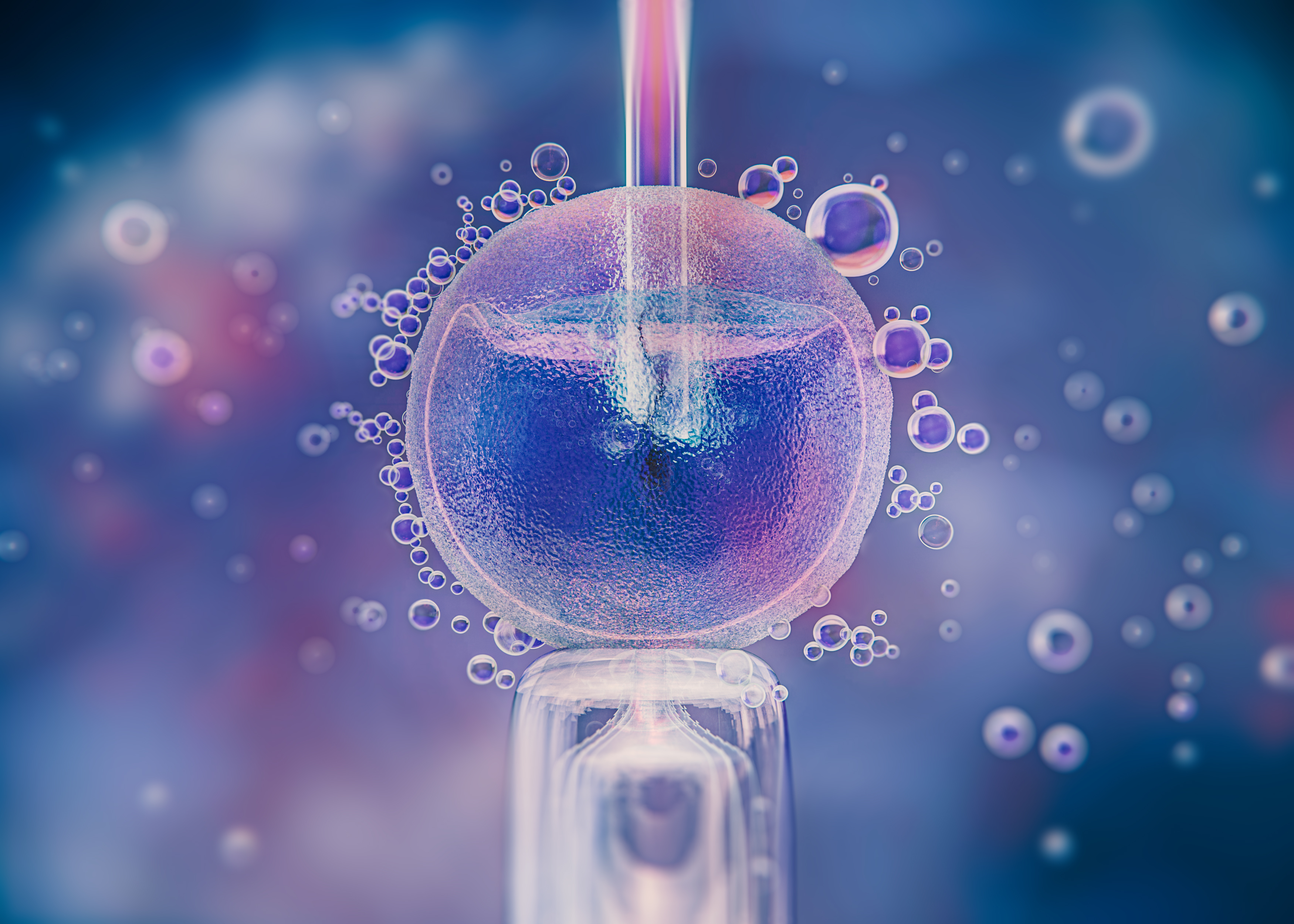
IVF is a medical procedure where a woman's egg and a man's sperm are fertilized outside the body, in a laboratory. It is a form of Assisted Reproductive Technology (ART), typically tried when other fertility methods have not succeeded.
In natural conception, an egg and sperm fertilize inside the woman's body. The fertilized egg attaches to the womb lining and develops over approximately nine months. IVF replicates this process outside the body using medical intervention.
IVF is generally recommended after other, less invasive fertility treatments have not worked. It involves significant medical intervention, hormonal stimulation, and financial investment — and is not typically a first step.
Fertility drugs are administered to stimulate the ovaries to produce multiple eggs — rather than the one or two that occur naturally in a normal cycle.
At mid-cycle, under anesthesia, an ultrasound-guided needle is inserted through the vaginal wall to retrieve the matured eggs from the ovaries.
The retrieved eggs and the male partner's sperm sample are combined in a laboratory. Fertilized eggs become embryos and are monitored for development.
One or more viable embryos are selected and transferred back into the woman's uterus, with the hope that at least one will implant and result in a pregnancy.
PGD is a procedure used alongside IVF to test embryos for specific genetic conditions before they are transferred to the womb. It was originally developed to help families avoid serious hereditary diseases.
A few cells are biopsied from each developing embryo and sent for genetic evaluation. This testing can identify chromosomal makeup and screen for hereditary disorders. Based on results, specific embryos may be selected for transfer.
PGD was developed primarily to help couples carrying known genetic disorders have a healthy child. However, it has also been used to determine the sex of embryos — a practice that raises significant legal, ethical, and social concerns.
Under the Pre-Conception and Pre-Natal Diagnostic Techniques (PCPNDT) Act, sex selection is strictly prohibited in India. PGD may only be used to screen for genetic diseases and chromosomal abnormalities — never for sex determination or selection. Violations carry serious legal consequences.
IVF and PGD are significant medical procedures. Before choosing this path, it is important to be fully informed about what they involve.
No guaranteed outcome. A transferred embryo does not guarantee a live birth. IVF success rates vary significantly by age and individual health factors.
High financial cost. IVF with PGD is medically invasive and expensive, putting it out of reach for the majority of families — even those who genuinely need it.
Emotional burden. The process can be physically and emotionally demanding — repeated cycles, hormonal side effects, and uncertainty take a real toll.
Unused embryos. IVF often produces more embryos than are used. Decisions about extra embryos — donation, disposal, or research — are ethically complex.
Not universally offered. Not every clinic provides IVF with PGD, and some refuse it for non-medical reasons. Availability varies widely.
Errors can occur. PGD is not 100% accurate. Genetic testing errors, though rare, do happen — it is not a perfect science.
Both paths have their place. This comparison is not about right or wrong — it is about helping you make a fully informed choice for your family.
Medical, surgical, laboratory-based
Holistic, lifestyle & nutrition-based, non-medical
High — injections, anesthesia, procedures
None — no medical procedures involved
Very High — often ₹1.5L to ₹3L+ per cycle
Accessible — fraction of IVF cost
Diagnosed infertility where natural conception is not possible
Couples seeking natural conception support before or instead of medical intervention
Clinically intensive; can be stressful and isolating
Empowering, couple-centred, and holistic — mind, body, and relationship
No guarantee — varies significantly by age and health
No guarantee — focuses on optimising natural conditions for conception
Each IVF cycle: 2 to 6 weeks; multiple cycles often needed
3 to 6 month programme; building long-term reproductive wellness
PGD for sex selection is illegal in India under PCPNDT Act
Fully compliant — no diagnostic or medical procedures performed
After natural options have been exhausted; under medical supervision
As a first step — or alongside medical care — to support natural fertility
Before taking an irreversible medical step, explore what your body is capable of with the right support. The BabySutra programme is designed to help you understand and optimise your natural fertility — gently and holistically.
The information on this page is provided for educational purposes only. The BabySutra does not provide medical advice, diagnosis, or treatment. If you are experiencing fertility challenges, please consult a qualified medical professional. The BabySutra's programmes are non-medical, lifestyle and wellness-based, and are not a substitute for medical care.